Pages

Showing posts with label Design Car. Show all posts

Thursday, May 26, 2011

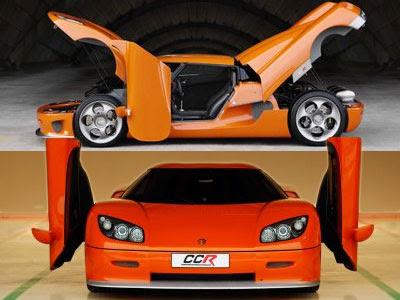
Koenigsegg CCR Design Sport Car Concept

Koenigsegg CCR Design Sport Car Concept

Koenigsegg design aims to give an interpretation of strength and flowing movement. The body of a Koenigsegg is formed for one ultimate aim, speed. Both the body and chassis of a Koenigsegg are made of lightweight composite carbon fiber, reinforced with Kevlar and aluminum honeycomb. Not surprisingly, the downside is very low downforce, just 50kg front and 70kg at the back. For comparison, an Enzo generates 775kg while Pagani produces 500kg. The entire body is carbon fiber.

Koenigsegg design aims to give an interpretation of strength and flowing movement. The body of a Koenigsegg is formed for one ultimate aim, speed. Its beauty is the beauty of speed itself. The surfaces are shaped to perfectly aerodynamic, something that does not deceive. All aspects of this machine serve its one fundamental objective with. Both the body and chassis of a Koenigsegg are made of lightweight composite carbon fiber, reinforced with Kevlar and aluminum honeycomb. Its race-bred suspension system brings the driver in control of every movement, even under the most difficult race.
The car was designed by Christian von Koenigsegg himself but its shape is largely dictated by aerodynamics. It is not so surprising as Enzo and Pagani. In some corners it seems too bulky, like a great whale. But the whale has a sense of power that can not be found in one of his rivals. Due to the targeted top speed, the body is designed to be so delicate that a very low drag coefficient of 0.30. This is much lower than Enzo (0.36), SLR (0.37) and the Carrera GT (0.39). Not surprisingly, the downside is very low downforce, just 50kg front and 70kg at the back.
For comparison, an Enzo generates 775kg while Pagani produces 500kg.
The frame is built like other supercar. Central to it is a carbon fiber tub (Koenigsegg called "semi-monocoque") attached with steel subframe at the front and the rear aluminum subframe to mount the engine, gearbox and suspension. Chassis rigidity is 28,100 Nm per degree, despite the roof plate. The entire body is carbon fiber. Koenigsegg says a dry weight of 1175 kg, which translates to 1275kg when fluid and fuel are loaded, ie, that which usually refer to "tare". In other words, is about CC8S light as Pagani and Saleen S7, whilst being around 100 kilograms lighter than Enzo and Carrera GT.

Porsche 917 Concept design

Porsche 917
The results of the Stile Italiano Giovani 2008 design competition have been revealed. ANFIA (Association of the Automotive Industry) Italian Car Coachbuilders Group decided that the Porsche 917 Concept designed by Adriano Stellino is the winner of the contest, Lamborghini Lidia Concept by Luis G.Camino Calleja is the runner-up, while Shashwath Bloar’s Trioba 2+1 Concept came third.
Porsche 917
The winner, the 917 Concept was designed to continue Porsche’s tradition, because, as we see, it inherited Le Mans 24 Hours winner’s car name. Its looks are great even though the conventional spoiler have been replaced by two wings, making the car more aggressive.
Porsche 917
Everything was designed to reduce the weight of the car: even the dashboard, the steering wheel and the pedals were made of carbon fiber, not to speak about the bodywork. The rims are made of a mixture of carbon and magnesium. A camera positioned under the roof, has replaced the conventional rear mirrors.

Mustang Saleen S7 Twin Turbo Design Sport Car

Mustang-Saleen-S7-Twin-Turbo-Design-Sport-Car

Saleen knows all about power. As in S281 Mustangs, N2O Focuses and the S7, America’s first (and still the only) mid-engine exotic supercar. When it went on sale in 2002, the S7 was the only street-legal car in the U.S. with more than 500 horsepower and 500 lb-ft of torque. The media and S7 owners have raved about the car since it first smoked the rear tires in anger. And it has been recognized by numerous automotive magazines as the fastest production car in the world. But during the past three years the automobile marketplace has witnessed an explosion of performance with models from manufacturers including Ferrari, Lamborghini, Mercedes-Benz, Porsche and Chevrolet touting power numbers above the once magic 500 level.
Designed by Saleen engineers, the S7's engine and drivetrain incorporate the latest in modern racing technology. The new all-aluminum V8 engine casting was engineered and tooled by Saleen to displace seven liters. Redline is 6500 rpm. Space age materials and engineering are used throughout, including stainless steel valves, titanium retainers, beryllium exhaust valve seats, an aluminum throttle body, Saleen designed aluminum CNC-machined cylinder heads and stainless steel exhaust system. An exclusive Saleen-designed Front Engine Accessory Drive (FEAD) system results in an extremely compact engine, allowing for better packaging and overall weight distribution. The V8 incorporates a unique Saleen-designed side-mounted water pump, a belt-driven camshaft drive and a Saleen-engineered dry sump oil delivery system. The engine's mid-chassis placement optimizes weight distribution and center of gravity, making room for an unusually tall engine that allows for a very efficient induction system. Air enters a roof intake, passes through a 90-mm mass air meter and feeds into a carbon fiber plenum. From the plenum the air is routed to the twin ball bearing turbos, is pressurized to 5.5 psi max and then passes through an oval-bore throttle body into an aluminum intake manifold with eight individual runners.