Pages

Showing posts with label 2011. Show all posts

Thursday, May 26, 2011

ALPINA B7 BMW luxury Sport Sedan

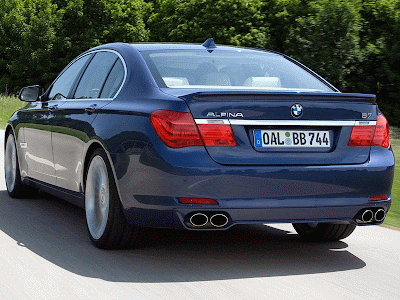
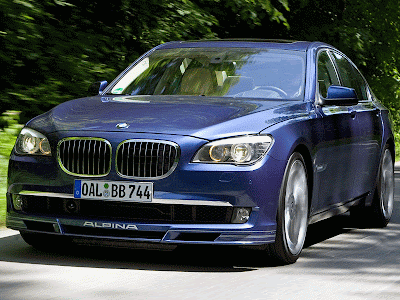
Both short- and long-wheelbase models will be offered. The BMW ALPINA B7 will make its North American premiere at the 2010 Chicago Auto Show in February, and go on sale at authorized BMW Centers in Spring of 2010. Bmw announced today the prices for the 2011 Alpina B7 for US - $122,875 (standard wheelbase) and $126,775 (extended wheelbase). BMW of North America announced that the BMW ALPINA B7 sedan will join BMW’s North American product range as the most dynamic 7 Series model. The BMW ALPINA B7 represents the second generation of ALPINA automobiles based on the BMW 7 Series to be offered in the US. The first BMW ALPINA B7 was offered as a limited edition for the 2007 and 2008 model years. Newly interpreted and based on the current BMW 7 Series platform, the B7 will again set the benchmark in terms of performance, refinement, technology, luxury and exclusivity. However, Alpina B7 is slightly less powerful that the 760i, but it looks very very sporty and aggressive.
ALPINA B7 BMW luxury Sport Sedan

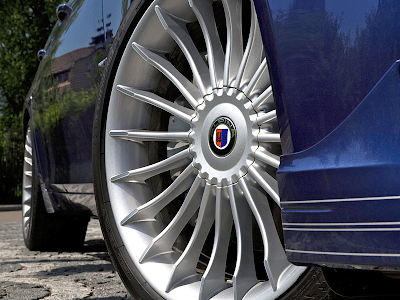
Yielding exquisite levels of power and torque from the twin-turbocharged 4.4 liter V8, and in conjunction with the electronically-adjustable suspension with active roll stabilization, the new B7 promises to offer a spectrum of driving experiences so broad as to be unheard of in this class of automobiles. The evolution of the traditional 20-spoke 21” ALPINA CLASSIC wheels underline the fresh design language found throughout the B7 and impart it a distinctive appearance and powerful stance.
ALPINA – a name famous in Europe and the wider world for putting a particular performance accent on BMWs, though not yet so well-known in North America. BMW – a name famous all over the world for motor vehicles of performance, quality, luxury and safety.
The two companies, both at home in the German state of Bavaria, have a long history of working together to produce special BMW automobiles. Burkard Bovensiepen, son of the founder of ALPINA Business Machines and an enthusastic racing driver/engineer, began his automotive career path in 1961 by developing a dual-carburetor setup for the just-introduced BMW 1500 sedan. It was a predictive beginning: to take an already fine-performing BMW (which also just happened to be a practical sedan) and making it perform even better.
ALPINA B7 BMW luxury Sport Sedan

By 1964, BMW had officially recognized ALPINA’s contribution to BMW performance. Not long thereafter, Burkard Bovensiepen founded the ALPINA company – ALPINA Burkard Bovensiepen KG – that continues today, creating special versions of BMW automobiles that offer a particular brand of performance for discriminating auto enthusiasts. Yet outside the circle of dedicated BMW enthusiasts, ALPINA has kept a low profile in North America. In addition to racing versions of BMWs, ALPINA has developed a progression of BMW-based cars based on 3, 5, 6, 8, Z4 and Z8 models and offered them on a limited-production basis. ALPINA is located in the small Bavarian city of Buchloe, some 50 miles southwest of Munich, BMW’s headquarters city and the capital of Bavaria.
ALPINA B7 BMW luxury Sport Sedan

The B7 is the newest manifestation of the unique BMW-ALPINA synergy – once again based on the BMW 7 Series luxury sedan. Currently, BMW offers ultra-performance models of its 3, 5, 6, X5 and X6 Series developed by BMW M, BMW’s own performance subsidiary. For an ultra-performance version of the 7 Series – a vehicle defined by luxury and generous interior space – something other than “M” performance character was called for. In recent models, ALPINA has concentrated on delivering very high levels of performance with moderate rpm ranges and automatic transmission. Most appropriately, the new BMW ALPINA B7 applies this philosophy to the newest 7 Series to produce a luxury sedan of stunning performance. “A 7 Series Beyond,” one might say.

Koenigsegg Agera, 2011

Koenigsegg Agera, 2011


Koenigsegg celebrate 15 years of making dream cars, by unleashing their latest jewel - the Koenigsegg Agera. A new supercar aimed to take the Koenigsegg experience to the next level, both on the road and the track.

Agera, the Swedish verb "to act", has been chosen as the name for Koenigsegg´s latest super creation, as it symbolizes the Koenigsegg philosophy well. Koenigsegg is always striving forward, seeking challenges beyond limitations. The new supercar Koenigsegg Agera is an outcome of that creative process and its functions respond very well to the given name.

A testament to time
The Koenigsegg Agera is a testament to time. The original shape and concept of the Koenigsegg CC, created 15 years ago, is still valid, fresh and highly competitive today. The Koenigsegg Agera still stay true to the original philosophy, shape and size of the original CC. At the same time, it looks, feels and performs like something belonging to the future, with all new content.

A Supercar is not better than the tires it use, as it is the only link between the road and the car. Therefore Koenigsegg has a deep and long term collaboration with Michelin, when it comes to tire development. The Koenigsegg Agera program will take this collaboration to the next level and is expected to set new standards when it comes to overall performance -wet as well as dry handling.

The Koenigsegg Agera is as wide at the front as in the rear of the car. This gives very good balance in corners and minimizes body roll.

The Koenigsegg Agera also features the latest in braking technology, incorporating an adjustable ABS system, 392x36 and 380x34 ventilated and drilled ceramic discs, for unparalleled braking performance and zero fade regardless of track or road condition.Thanks to optimized breathing and Twin Turbo, power is now 910 hp, running on regular petrol. Torque is maximum 1100 nm and is reached at 5100 rpm. There is over 1000 nm of torque available from 2680 to 6100 rpm.

The new traction control is the fastest reacting in the industry, with auto adapt functionality for different road conditions and driving styles as well as several manual settings.

Koenigsegg has also developed a new type of interior illumination, which is a worlds frst in the car industry - Ghost light. The illumination shines through the billet aluminium buttons and surfaces by way of invisible nanotubes, creating excellent visibility of the symbols, as well as a very clean and stylish appearance, framed by an all-new carbon fbre centre console and tunnel assembly.

Furthermore, the driver can easily select the information he wants displayed in front of him, on the all new multi-info cluster combined with the upgraded infotainment display, ranging from basic functionality, to G force meter, power meters, Sat-nav, music, lap-timer or compasses - to best suit the current driving conditions, be it highway cruising, touring country roads, city navigation or serious track driving. Furthermore the interior features the new Koenigsegg Agera stitching and seams, which gives an beutiful fuidity to the interior.

All in all the Koenigsegg Agera is created to maintain Koenigsegg's position as one of the most engaging and top performing cars on the road, on the track -on the planet. Still, maintaining the largest luggage space in the industry and the novel Koenigsegg doors and detachable/stow able hardtop, that really makes all Koenigsegg cars stand out.

The Koenigsegg Agera will be produced in parallel to the Award winning CCX and CCXR models. This gives Koenigsegg the ability to live up to our customers varying wishes and demands. The Agera is on display at the 80th Salon International de l'Auto in Geneva. The pre-production show car will be put through its phases for the coming six month prior to the production car launch of the Agera. Finally, Agera is also short for the Greek word Ageratos, which in ancient Greek means "ageless".

Dacia Duster, 2011

Dacia Duster, 2011


The Dacia Duster project was born out of the simple premise that a real need existed in the world for an affordable, comfortable and rugged 4x4, a class which is currently not well served. Aware of this gap, the Renault group decided to develop an all-terrain vehicle aimed initially at emerging markets. The needs of European customers were also taken into account from the project outset.

In Europe, Dacia's success has highlighted the demand for modern, reliable and affordable cars. Although the current range of 4x4s and SUVs is quite extensive, it neglects the call for a functional, affordable all-terrain vehicle, favouring instead SUVs that are expensive and often ill-suited to the needs of off-road driving.

Indisputable 4x4 looks
At first glance, Dacia Duster is clearly a 4x4. Its front end exudes a sense of ruggedness, with its imposing chrome grille and sump guard also pointing to its clear 4x4 credentials. Seen in profile, its high ground clearance, wide wheel arches and body protection are an open invitation to take on even the toughest surfaces.

Dacia Duster was designed to tackle all types of roads and tracks, all over the world. In order to meet these varied needs, it will be available in all markets in both 4x2 form (for customers looking for good ground clearance and a high driving position, without the need for four-wheel drive) and with 4x4 transmission for off-road driving.

Dacia Duster's strengthened undercarriage is suitable for dirt roads and all-terrain use thanks to its high ground clearance (more than 200mm) and impressive clearance angles (approach angle: 30 degrees; departure angle: more than 35 degrees).

Dacia Duster is easy to drive and not only aimed at all-terrain drivers. Its combination of its low unladen weight (1,180kg in 4x2 - 1,280kg in 4x41) and compact proportions, ensure particularly agile handling. In the 4x4 version, thanks to the unique and intuitive control (sourced from Nissan) located at the foot of the centre console, Dacia Duster drivers can easily adapt the vehicle's transmission configuration to meet their needs of the moment. This control allows one of three modes to be selected:

When the AUTO mode is selected, the front/rear torque split is calculated automatically as a function of available grip. This system is aimed at providing optimal traction, however much grip is available, and gives Dacia Duster genuine 4x4 ability. In normal conditions, the torque is transmitted through the front wheels only. If traction is lost, or when grip is at a premium, some of the torque is transferred to the rear axle. In extreme conditions, the torque is split equally front and rear. This split is performed by an electromagnetic torque converter supplied by Nissan.

In LOCK mode, the driver electronically locks it into 4x4 mode, whereby 50 per cent of torque is consistently fed through the rear axle. This mode is recommended in low grip conditions (snow, mud, dirt, sand) at low speeds.

In 4x2 mode, the transmission is locked into two-wheel drive. This mode is suited to driving on good roads and reduces fuel consumption.

A DACIA 4x4 WHICH DELIVERS ALL THE STRENGTHS EXPECTED OF THE BRAND
Dacia Duster, the sixth vehicle in the Dacia range, remains true to the brand's philosophy by offering unbeatable cabin space for its price, plus low running costs thanks to its thrifty fuel consumption, as well as a high level of safety and reliability whatever the conditions.

Unbeatable cabin space for its price
Although Dacia Duster's price is comparable with that of a city car, its exterior and interior dimensions are more akin to those of a compact car from the segment above. It comfortably seats up to five adults, with both front and rear occupants enjoying the same amount of space as passengers in its sister Logan model.

Dacia Duster's boot capacity is unbeatable, too, with a volume of up to 475dm3 ISO. With the rear benchseat folded and tipped forward, its impressive carrying ability can even exceed 1,600dm3 ISO.

Reliable engines with good fuel economy and low CO2 emissions
Both the 4x2 and 4x4 versions of Dacia Duster will be available with either a 1.6 16V 110hp petrol engine, or 85hp or 105hp dCi diesel power. All three powerplants have already demonstrated their efficiency under the bonnet of a number of Renault group models.

These engines are perfectly suited to the criteria of cost, strength and ease of maintenance that are a hallmark of the Dacia range. Combined with Duster's low weight, they ensure that Dacia's newcomer returns low fuel consumption and boasts impressive ecological credentials, with the dCi diesel versions emitting less than 140g of CO2/km in 4x2 form (qualifying Duster for the Dacia eco² signature) and less than 150g of CO2/km in the case of the 4x4 versions.

Safety: an absolute priority
Reliability and strength: Dacia fundamentals
Like all the vehicles based on the B0/Logan platform, Dacia Duster has been engineered to deliver the hallmark strength and reliability motorists have come to expect of the brand.

Particular attention has been paid to anti-corrosion protection thanks to several precautions:
    * wax-injected underbody and opening panel hollow sections,
    * mastic sealing of exterior joints,
    * additional wax treatment of underbody mechanical components,
    * stone-chip protection for underbody, sills and wheel arches.

2011 Pagani Zonda Tricolore - Pagani Unique Hypercar

Pagani Automobili created the Pagani Zonda Tricolore on the occasion of the celebration of the 50th Anniversary of the "Frecce Tricolori", as a tribute to the National Aerobatic Team.
2011 Pagani Zonda Tricolore
Pagani will introduce the rare cars in the Geneva Motorshow, the 2011 Pagani Zonda Tricolore. Pagani has come up with a new carbon fibre finish for the body of the Zonda Tricolore and there are unique air intakes mounted on top of the rear wings styled to look like the intakes of the jet fighters used by the display team.
2011 Pagani Zonda Tricolore
In 2010 the aerobatic season of the Frecce Tricolori comes to its 50th anniversary, wich will be celebrated on 11th and 12th September at Rivolto Airport.
2011 Pagani Zonda Tricolore
The Frecce Tricolori (Italian, literally Tricolour Arrows), officially known as the 313th Aerobatic Training Squadron is the demonstration team of the Italian Air Force, based at Rivolto Air Force Base, in the north-eastern Italian region of Friuli Venezia-Giulia, province of Udine. They were formed in 1961 as an Air Force team, replacing previous teams that had been sponsored by various commands by the end of the 1920s.
2011 Pagani Zonda Tricolore
The Tricolore comes with a 678bhp version of the Zonda’s 7.3-litre V12, Mercedes-sourced engine and it’s good for 0-62mph in 3.4 seconds and a top speed of 220mph. You’ll need to be as quick as the FrecceTricolore to grab the £1.3 million Pagani Zonda Tricolore though, as Pagani reports several customers have shown an interest in buying the unique hypercar. You should see the Photos Car of the unique design.
2011 Pagani Zonda Tricolore
The team flies the Aermacchi MB-339-A/PAN, a two-seat aircraft capable of 898 km/h at sea level, with nine aircraft and a solo (the highest number of aircraft of any aerobatic team in the world).
2011 Pagani Zonda Tricolore
The Frecce Tricolori belong to the legacy of the entire Italian community. This special edition Zonda is named after the Italian air force aerobatics team, known as the Frecce Tricolori. Italian colored stripes (red, white, green) running up the nose of the car and LED running lights set this Zonda apart from the others. Only 1 will be made at a cost of $2.75 million.
2011 Pagani Zonda Tricolore

2011 Koenigsegg Sports Car Agera - Celebrate 15 Years

Geneva Motor Show 2010 - The new Koenigsegg Agera. To celebrate 15 years of making dream cars, Koenigsegg unleash their latest jewel, the Koenigsegg Agera. A new supercar aimed to take the Koenigsegg experience to the next level, both on the road and the track.
2011 Koenigsegg Agera
The Agera is on display at the 80th Salon International de l’Auto in Geneva. The Agera shares some styling tweaks that are similar to the CCX and owes its name to the Swedish translation of “to act”, thus symbolizing the Koenigsegg philosophy of always improving its cars and pushing its designs to the limit.
2011 Koenigsegg Agera
Koenigsegg Agera is powered by Twin Turbo engine with 910 hp in term of running on regular petrol. Coming on to the major details, based on the regular CC, the Koenigsegg Agera boasts of a 4.7-liter twin turbocharged V8 producing 910 PS (669 kW/898 hp) at 6850 rpm and 1100 Nm (811 lb-ft) at 5100 rpm. There is over 1000 nm of torque available from 2680 to 6100 rpm.
2011 Koenigsegg Agera
To balance this, the Agera features the latest in braking technology with 392×36 and 380×34 ventilated and drilled ceramic discs. When combined with a dry weight of just 2,832 lbs and the sequential gearbox the Agera can sprint to 100 km/h in as little as 3.1 seconds, 200 km/h (124 mph) in 8.9 seconds and blast on to a top speed of 245+ mph. As well, new traction control is fitted with auto adapt functionality for different road conditions and driving styles as well as several manual settings.

2011 Koenigsegg Agera
Beside the new engine performance, Koenigsegg also features the new Koenigsegg Agera stitching and seams for Agera interior and has developed a new type of interior illumination, which shines through the billet aluminum buttons and surfaces by way of invisible nanotubes.
2011 Koenigsegg Agera
The Koenigsegg Sports Car Agera will be produced in parallel to the Award winning CCX and CCXR models. The pre-production show car will be put through its phases for the coming six month prior to the production car launch of the Agera. Pricing details have not been revealed as of now but it is being said that the supercar maker will bring a pre-production model of the Agera to the Swiss Motor Show. According to GTSpirit, just 16-20 Agera models will be built each year, starting later this year.

Hyundai Sonata Midsize Sports Sedan

Hyundai introduced its all-new Hyundai Sonata at the 2009 Los Angeles Auto Show. This marked the North American debut of the latest version of the popular midsize sedan, introducing Hyundai's "Fluidic Sculpture" design language and an all four-cylinder engine lineup to the U.S. market. Hyundai Sonata is the second vehicle in Hyundai's 24/7 version 2.0 product initiative (seven new models in the next 24 months) following on the heels of the all-new Tucson. Production of Hyundai Sonata will begin in December 2009 at Hyundai's U.S. plant in Alabama with retail sales beginning in January 2010.
Hyundai Sonata Midsize Sports Sedan
The new Sonata will launch with Hyundai's new Theta II GDI 2.4-liter four-cylinder engine with a Gasoline Direct-Injection (GDI) fuel delivery system, which contributes to improved fuel efficiency and lower emissions. Hyundai Sonata is the first midsize sedan to adopt GDI technology as standard equipment in a naturally aspirated powertain. This shorter, more direct path of fuel delivery, allows for greater control of the fuel mixture at the optimum moment, thus improving efficiency. The fuel is injected by a camshaft-driven, high pressure pump that operates at pressures up to 2,175 psi. Direct injection also utilizes a higher than normal 11.3:1 compression ratio for increased power. The pistons are "dished" to increase combustion efficiency in the cylinder. This powerplant will deliver best-in-class fuel economy, best-in-class four-cylinder horsepower and best-in-class torque.
The Sonata 2.0T, as the car is officially named, is powered by a new 2.0-liter Theta II twin-scroll turbocharged gasoline direct-injection (GDI) engine that produces 274 horsepower at 6,000 rpm and 269 lb-ft of torque from 1800-4500 rpm with regular fuel. The engine is linked to a six-speed automatic transmission with SHIFTRONIC manual control that drives the front wheels. No performance figures were released but Hyundai did announce that the Sonata 2.0T will deliver an estimated 22 mpg (10.7lt/100km) city and 34 mpg (6.9lt/100km) highway.
The 2.0-liter twin-scroll turbo engine will be available on the Sonata SE and Limited trim level, with the Limited getting additional upgrades, including a panoramic sunroof, 18-inch "hyper" silver alloy wheels, dual exhaust system and steering wheel-mounted paddle shifters.
Next year, Hyundai will add a 2.0-liter Theta II turbocharged GDI four-cylinder engine and a 2.4-liter Hybrid Blue Drive model featuring Hyundai's breakthrough lithium polymer battery pack. Details about these powertrains will be announced at the 2010 New York Auto Show. Hyundai Sonata's innovative segment first powertrain lineup is a key driver of Hyundai's goal to be the most fuel-efficient automaker on the planet.
Hyundai's commitment to making the Hyundai Sonata extremely fuel efficient continues with a six-speed automatic transmission with SHIFTRONIC manual control or a standard six-speed manual transaxle. Hyundai's all-new six-speed automatic A6MF2 transaxle helps the company meet its goals of improving fuel efficiency and reducing emissions. Shifts are silky-smooth with an option of manual control through the SHIFTRONIC feature.
Developed over a four-year period, this new six-speed automatic is 26.4 pounds lighter than the five-speed it replaces. It also is 1.6 inches shorter and considerably simpler, having 62 fewer parts, which is a key to increased durability, lighter weight and lower cost. When it comes to transmissions, more gears are definitely better. The addition of a sixth gear enables closer spacing between gear ratios providing a better balance of performance and fuel economy while the wide overall gear ratio helps deliver strong acceleration.
All Sonatas have column-mounted, motor-driven electric power steering that adjusts instantly to changing driving conditions while improving fuel economy over a conventional steering system. A quick-ratio steering rack is used for crisp feel on turn-in. Hyundai Sonata's turning diameter of 35.8 feet is better than Camry, Accord, Altima, Fusion and Malibu.
One of the program targets for the 2011 Sonata engineering team was world-class power-to-weight ratio. Power-to-weight ratio pays dividends in both performance and fuel economy. Hyundai Sonata is rich in ultra-high-strength steel, leading to world-class body rigidity. The 2011 Hyundai Sonata is 25 percent stiffer in torsion and 19 percent stiffer in bending rigidity than its predecessor, yet it is lighter than many midsize sedans, also offering more interior room.
The 2011 Sonata is a smart combination of superior styling, performance, safety and fuel efficiency. What’s more, it’s an affordable midsize car, putting a luxurious and rewarding driving experience within reach of many. Make the 2011 Sonata a part of your future.

2011 SLS AMG GT3 Mercedes-Benz - Luxurious Super Sports cars

The Mercedes-Benz SLS AMG is one of the biggest supercar releases of the past year. But the company isn't content with just making ultra luxurious supercars for the rich and well dressed, they also plan on releasing a fully homologated GT3 race version for the gentleman racer.
2011 SLS AMG GT3 Mercedes-Benz
The GT3 racing version of the SLS AMG is powered by the same mid-front mounted 6.3 litre V8 engine as the road car. There'll probably be a few modifications for the race unit, but Mercedes haven't yet announced final power outputs or specifications. Or even a final weight figure. That's all for the FIA to decide in the near future as part of the homologation process.
2011 SLS AMG GT3 Mercedes-Benz
Power transmission in the SLS AMG GT3 is done through a six-speed sequential racing transmission with steering wheel shift paddles and an integrated multi-disc locking differential. As in the SLS AMG road car, the transmission is located at the rear axle for better weight distribution: the engine and transmission are connected by a torque tube within which a carbon-fibre shaft rotates at the engine speed.
2011 SLS AMG GT3 Mercedes-Benz
The Mercedes SLS AMG GT3 is instantly recognizable as belonging to the SLS AMG family - as any GT3 racer is. The biggest visual changes are a new front apron, new splitter, redesigned bonnet with additional air intakes and vents, new sideskirts which have air inlets for cooling the rear brakes, rear diffuser and a prominent adjustable rear wing. The C-pillars provide housing for the standardized filler pipes for the fast-refuel system.
2011 SLS AMG GT3 Mercedes-Benz
The communication of Daimler release says that “the AMG V8 engine with 6.3-liter is identical to that used in the serial sports car. With a low weight, however, sports car accelerates from standstill to 100 km/h for only 3.7 seconds (serial sprint for 3.9 seconds). The maximum speed was announced for 300 mph, but producers say they have more opportunities to raise her brakes are racing by AMG, as disks are ventilated. Front wheels are size 12×18, rear 13×18.
2011 SLS AMG GT3 Mercedes-Benz
Powering this race car is a 6.3-Liter V8 engine that produces 600HP and controlling all this power is a six speed racing transmission system with shift paddles mounted on the steering wheel. The SLS AMG GT3 is designed as a racing sports car for customers competing in sprints and long-distance races.
"Thanks to uncompromising lightweight construction and superior handling dynamics, the SLS AMG provides an outstanding basis for a highly competitive racing car. This exciting GT3 version is our response to strong customer demand for a car designed for these attractive motor sports car series," says Volker Mornhinweg, Chairman of Mercedes-AMG GmbH.
2011 SLS AMG GT3 Mercedes-Benz
The body of the 2011 SLS AMG GT3 is the most significant difference from the road car starting with the aggressive front fascia and splitter to the massive rear spoiler. The hood of the race model is also very different from the normal SLS AMG with a large center cooling vent that helps to move air to cool the engine and the braking system. Along the side of the car, vents have been added to cool the rear brakes without compromising aerodynamics and all of these improvements to the overall cooling effort of the car makes it ideal for long road races like the 12 Hours of Sebring.
2011 SLS AMG GT3 Mercedes-Benz
The SLS AMG GT3 is equipped with a six-speed racing transmission with sequential shift. A steering wheel with a diameter of 13 inches facilitates perfect vehicle control. Because it is open at the top, the driver always has a perfect view of the central display, which provides all relevant information such as road speed, engine speed, operating temperatures, lap times and gear selection. The SLS AMG GT3 is also equipped with precisely calculated cooling channels – openings in the front skirt and ahead of the rear wheels direct cool airflow over the brake discs. All four brake discs are ventilated, slotted and drilled.
The 2011 Mercedes-Benz SLS AMG race car is expected to delivery scheduled prior to the start of the 2011 racing season. However, interested customers can order this awesome vehicle starting in autumn 2010. The Mercedes-Benz display at the 2010 New York Auto Show, the 2011 SLS AMG will carry a starting price-tag of $183,000 when it goes on sale.

2011 New Opel Astra GSI Concept Cars Third Millennium

The new Opel Astra GSi will be unveiled in October at the Paris Auto Show and will go on sale later this year or early in 2011. The 2011 Opel Astra GSi will feature various new design elements, including a re-styled front bumper, new wheel arches, a small rear diffuser and double exhaust pipes.
2011 New Opel Astra GSI Concept Cars Third Millennium
Opel fans al already asking when will the new Astra GSI will make its debut. Today we have the answer for them: the new 2011 Opel Astra GSI will make its debut this autumn at the Paris Motor Show, according to the latest reports from Auto Motor und Sport.
The new Opel Astra GSi 5-door layout back to talk about himself, with eloquent spy photos. The famous symbol will return to sport compact Russelsheim later this year. In fact, the Astra GSi will officially introduce yourself to October at the Paris Motor Show and will be sharing the catwalk in Paris with the new Sports Cars Tourer estate.
The new vehicle will carry, as expected, a 2.0-liter Turbo engine which will deliver around 190 hp… we do hope that this will get at least 200 hp in order to take on the Vw Golf GTI. Regarding the OPC version this will carry over 240 hp. The new Astra GSI will also come with a new body kit which will include wider wheel arches, a new front and rear bumper, new side sills, dual exhaust pipes and a dual-tone interior with Recaro sport buckets. Most sources say the 2011 Opel Astra GSi will only be available in the 5 door body style. The 3 door will be sold only as a OPC / GTC.
The new Opel Astra GSi be the top version of the variant 5-door, while the symbol OPC will be given only to the three-door GTC. The 2011 New Opel Astra GSi third millennium will be equipped with the 2.0 Turbo petrol engine, whose maximum should be around 190-200 horses. The Astra OPC boasts a 2.0-litre turbocharged motor with 177kW. The GSI should feature about 140kW or so.
The sports chassis will be recognizable to the wider wheel arches and front bumper changed. At the rear, as well as the letters GSi, Opel Astra in this version will be distinguished for the double exhaust. Even in the cockpit there are specific characterizations, such as two-tone sport seats.
The Astra GSi price will be announced at a later date.